What Happens When a 30,000-Hectare Farm Stops Fighting Its Own Size?
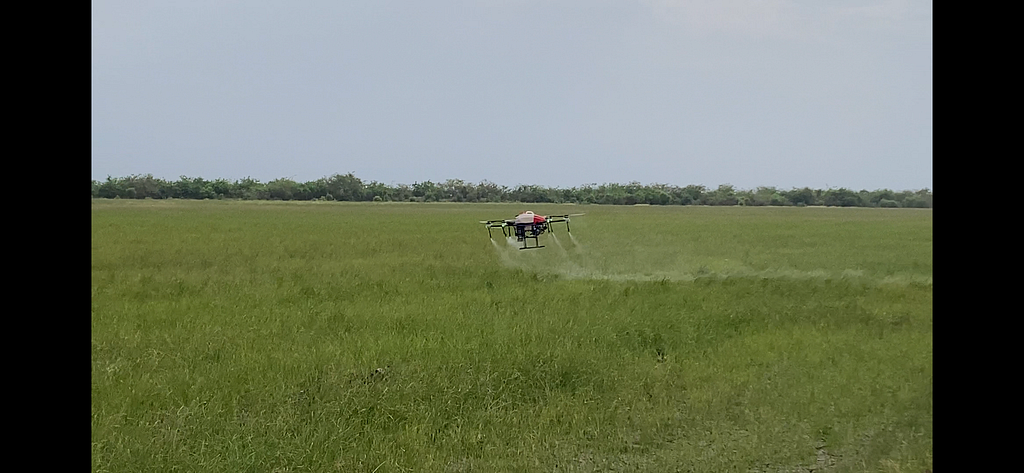
Yesterday we talked about the race every large-scale farmer participates in: by the time you finish spraying one side of the farm, the other side is already in trouble.
So what does it look like when a farmer and his farm stop losing that race?
Picture the same morning. The rain has settled, the pests have shown up, and you need to spray. But this time there’s no calling around for casual workers, no hauling water to the far end of the farm, no long line of people carrying chemicals on their backs.

A drone is loaded at the edge of the field. It lifts off, follows a mapped route over the crop, and sprays in a steady, even pattern. Nobody walks into the chemical. Nobody gets left behind at the wrong end of the farm. In 2022, Dangote invited us at BeatDrone to spray their 28,000-hectare sugar farm. Though we ran into bad weather, we still covered 100 hectares per day per aircraft. With our current capability as of 2026, we can now cover a groundbreaking 1,000 hectares per day per aircraft.

This isn’t a theory.
Some of the biggest names in Nigerian agriculture are already using it. Dangote Group has said that BeatDrone’s aerial spraying has significantly improved how crop treatment is managed across its farms, and that it is now expanding the drones into surveillance and protection of its agricultural assets. Olam Group, Nigeria, has described aerial spraying as an efficient and reliable solution for treating crops across its farms.
And the same spraying systems have been tested at a scale far beyond farming. During the COVID-19 response, they were deployed for large-scale disinfection in Lagos, Ekiti, Ondo, and Osun States. If a drone can cover areas that size under that kind of pressure, a farm is well within its reach.

Here’s how it answers the four problems from Part 1:
- Labour: fewer hands are needed, so there’s less recruiting, less supervising, and less waiting for people to show up.
- Uneven spraying: a drone follows a planned route, so the chemical goes where it should, in the right amount, with no corners missed and no corners drowned.
- Worker safety: the person operating the drone stays away from the spray, so fewer people breathe in the chemical.
- The weather: a job that takes hours instead of days gives rain a much smaller window to wash your money away.
But let’s talk about what you’re really wondering.
“Is this only for the Dangotes of this world?” The answer is a big NO; we are here to help you as much as possible as we can, to ensure the prosperity of agriculture in this part of the world. Do you offer spraying as a service so a farmer doesn’t have to buy a drone, hire a pilot, or learn the system? “Will it work on my crop and my land?” The answer to these questions is all YES.

Key Takeaway
A big farm will always be harder to protect than a small one. But it no longer has to be slower. The farms that win are the ones that stop asking their people to outrun the land and start letting the technology cover it.
So here’s the question to take back to your own farm:
How many hectares are you protecting the old way, and what would your next season look like if the spraying were finished before the pests could spread?
If you’re ready to find out, reach out to BeatDrone: [https://beatdrone.netlify.app/]
Beat Drone
Originally published on Medium